> For the complete documentation index, see [llms.txt](https://docs.iotex.io/llms.txt). Markdown versions of documentation pages are available by appending `.md` to page URLs; this page is available as [Markdown](https://docs.iotex.io/depin/builders/depin/ioid-step-by-step-tutorial/a-proxy-contract-approach.md).
# Integrate ioID in your cloud
A "Proxy Contract" Approach
In scenarios where a DePIN project cannot integrate ioID directly into their device’s firmware, this approach enables the project’s cloud to manage ioID registration and message signing on behalf of the devices. In this setup, a “Proxy ioID Contract” serves as an intermediary between the project’s cloud and ioID contracts. The cloud acts as a “trusted entity” within the proxy contract, authorizing on-chain ioID registrations and binding them to the actual device owner.
{% hint style="info" %}
**IoID Web Tools**
[IoID Web Tools ](https://hub.iotex.io/dev/ioid)are designed to streamline experimentation and development for integrating **IoID** into DePIN projects. These tools, currently under development by the IoTeX Foundation, aim to provide a seamless and interactive user experience for creating and managing IoID-based projects.
While this page explains how to register your project in IoID using the `ioctl` command line, you can achieve the same using the [IoID Web Tools](https://hub.iotex.io/dev/ioid) where you can list, and manage all your projects interactively, including deploying a default Device NFT contract.
{% endhint %}
{% hint style="warning" %}
* Ensure you followed the initial steps to [register your Project on the IoTeX chain](https://docs.iotex.io/depin/builders/depin/ioid-step-by-step-tutorial/pages/P7gaCFyrGpZe1V3tKvCD#id-1.-register-your-depin-project-on-iotex).
* Ensure you have development tools like git and nodejs installed
{% endhint %}
## Deploy the ioID Proxy Contract
### Deploy using Hardhat
If you haven’t already, clone the ioID-contracts repository:
```bash
git clone https://github.com/iotexproject/ioID-contracts
cd ioID-contracts && npm install
```
Export the private key for deploying the ioID Proxy contract.
{% hint style="warning" %}
This account will control your ioID proxy contract, particularly for setting the “Verifier” address. The “Verifier” is typically your service account responsible for managing ioID registrations on behalf of the devices on the cloud side
**Ensure you use a dedicated wallet account as the owner of your ioID Proxy contract. Whenever possible, consider using a hardware wallet for enhanced security on mainnet.**
{% endhint %}
```bash
export PRIVATE_KEY=0x
```
Export the ioID Store and Project Registry contract addresses (check the [repository on GitHub](https://github.com/iotexproject/ioID-contracts#deployment) for updated addresses):
```bash
export IOID_STORE=0x60cac5CE11cb2F98bF179BE5fd3D801C3D5DBfF2
export PROJECT_REGISTRY=0x060581AA1A4e0cC92FBd74d251913238De2F13cd
```
Deploy your ioID Proxy contract with:
```bash
npx hardhat run scripts/deploy-proxy.ts --network testnet
```
### Deploy using the ioID Web Tools
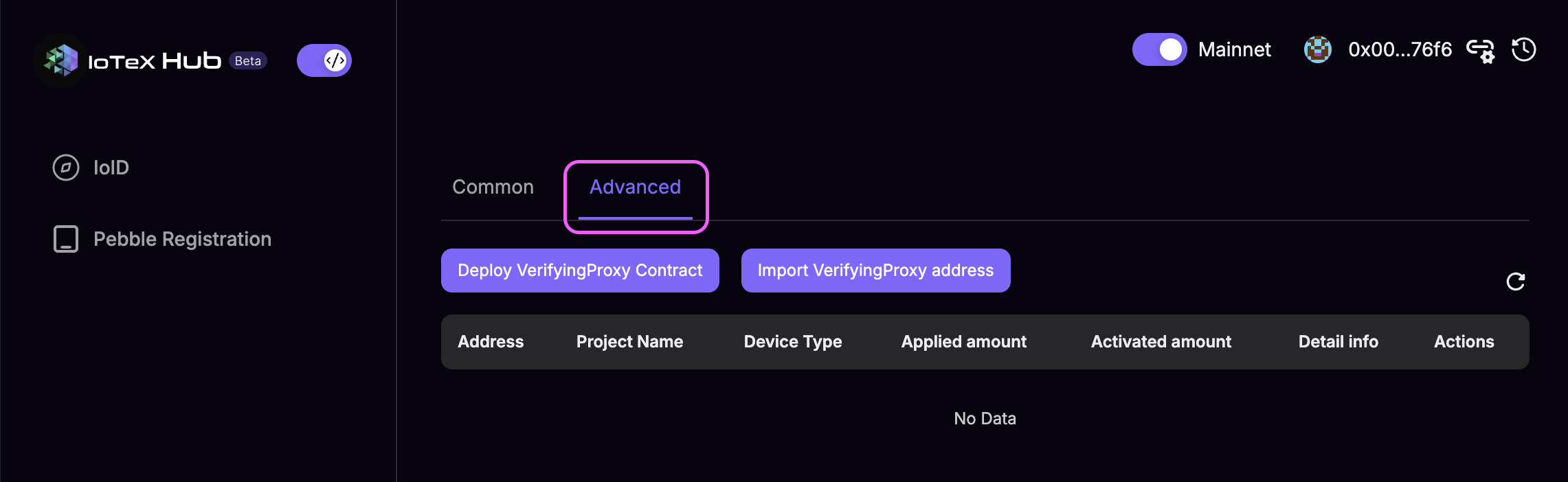
Developers can also deploy an ioID proxy contract and manage it interactively on the IoTeX Hub:
* Browse the [ioID Web Tools on the IoTeX Hub](broken://pages/GJHOGj04VpgqdwSuyc7O)
* Select the Advanced tab:
* Click the `Deploy VerifyingProxy Contract` button to deploy a new Proxy contract, or
* Click the `Import VerifyingProxy Address` button to import an already deployed Proxy
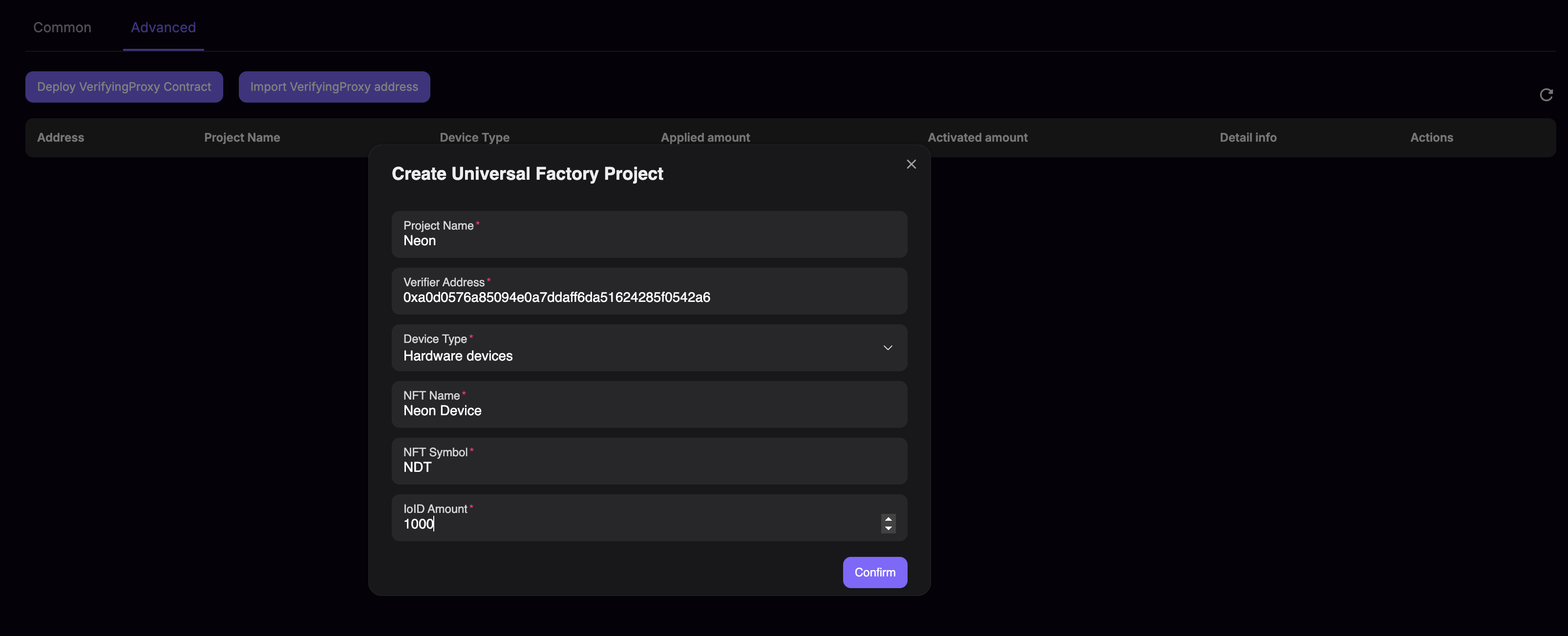
* Provice the required information then click `Confirm`
## Interact with the Proxy contract
Here is an example repository that shows how to generate ioIDs for your devices in the cloud and how to register them on-chain through the Proxy contract:
{% embed url="" %}
---
# Agent Instructions
This documentation is published with GitBook. GitBook is the documentation platform designed so that both humans and AI agents can read, navigate, and reason over technical content effectively. Learn more at gitbook.com.
## Querying This Documentation
If you need additional information that is not directly available in this page, you can query the documentation dynamically by asking a question.
Perform an HTTP GET request on the current page URL with the `ask` query parameter, and the optional `goal` query parameter:
```
GET https://docs.iotex.io/depin/builders/depin/ioid-step-by-step-tutorial/a-proxy-contract-approach.md?ask=&goal=
```
`ask` is the immediate question: it should be specific, self-contained, and written in natural language.
`goal` is optional and describes the broader end goal you are ultimately trying to accomplish on behalf of the user. GitBook uses it to tailor the answer towards what is most useful for that goal.
The response will contain a direct answer to the question and relevant excerpts and sources from the documentation.
Use this mechanism when the answer is not explicitly present in the current page, you need clarification or additional context, or you want to retrieve related documentation sections.