> For the complete documentation index, see [llms.txt](https://docs.iotex.io/llms.txt). Markdown versions of documentation pages are available by appending `.md` to page URLs; this page is available as [Markdown](https://docs.iotex.io/blockchain/learn-iotex/core-concepts/consensus-mechanism.md).
# Roll-DPoS Consensus
## Randomized Delegated Proof of Stake (Roll-DPoS)
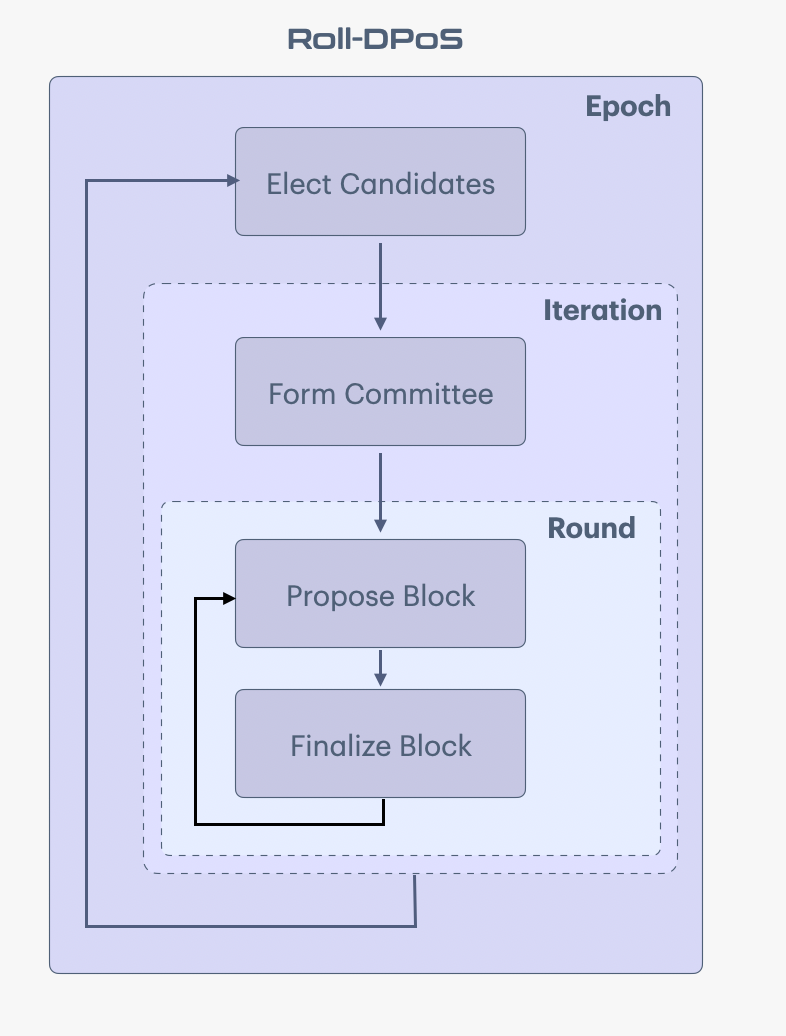
To have a fast and efficient consensus mechanism with instant block finality in the context of DePIN, the IoTeX blockchain combines the concepts of Delegated Proof of Stake (DPoS), Proctical Bizantine Fault Tolerance (PBFT) and Verifiable Random Functions (VRFs). VRF is a family of functions that can produce publicly verifiable proofs for the correctness of their random outputs. At a high level, our Roll-DPOS has four phases elect candidates, form committee, propose block and finalize block.
Randomized Delegated Proof of Stake (Roll-DPoS)
### Elect Candidates
All nodes in the IoTeX network participate this phase in terms of voting for the committee candidates. To encourage nodes to vote, the system makes sure the delegates share forged rewards with their voters. The candidates forms a set of at least 36 delegates; this number will increase in the future to further avoid the centralization of the mining power. Once the candidates are selected, they will be fixed in one epoch, which consists of 30 iterations.
### Form Committee
In each iteration, a random committee of size 24 is selected from the candidate pool using VRF for creating blocks in the next 30 rounds. The use of VRF is important as it provides a non-interactive way to sort all delegates for proposing blocks in a fairness and security way. To this end, we use the efficient VRF as being used in Algorand.
### Propose Block
In each round (which is roughly every 2.5 seconds), every committee node in turn proposes a new block and broadcasts it to the network, together with the the proof. Only the block proposed by the expected committee node and has not been proposed in the same iteration is considered by other nodes, which is called a candidate block.
### Finalize Block
In the same round, all other nodes use PBFT to vote for/against the candidate block. If more than 2/3 committee nodes agree on candidate block's validness, it is finalized and is appended to the blockchain by everyone in the network. After that, "propose block" and "finalize block" are executed in the next round; if the current iteration finishes, another random committee will be formed before propose block and finalize block are executed again.
---
# Agent Instructions
This documentation is published with GitBook. GitBook is the documentation platform designed so that both humans and AI agents can read, navigate, and reason over technical content effectively. Learn more at gitbook.com.
## Querying This Documentation
If you need additional information that is not directly available in this page, you can query the documentation by asking a question.
Perform an HTTP GET request on the following URL with the `ask` and `goal` query parameters:
```
GET https://docs.iotex.io/blockchain/learn-iotex/core-concepts/consensus-mechanism.md?ask=&goal=
```
`ask` is the immediate question: it should be specific, self-contained, and written in natural language.
`goal` is what the user is ultimately trying to achieve, the reason they need the answer. Sharing it helps GitBook give you a better, more relevant answer. A goal is most helpful when it describes the outcome the user wants rather than restating the question. For example, with `ask=how do I create an API token`, a goal like `automate deployments from our CI pipeline` lets GitBook tailor the answer to that use case.
The response will contain a direct answer to the question and relevant excerpts and sources from the documentation.
Use this mechanism when the answer is not explicitly present in the current page, you need clarification or additional context, or you want to retrieve related documentation sections.