> For the complete documentation index, see [llms.txt](https://docs.iotex.io/llms.txt). Markdown versions of documentation pages are available by appending `.md` to page URLs; this page is available as [Markdown](https://docs.iotex.io/blockchain/build/reference-docs/embedded-blockchain-clients/arduino-ide.md).
# Arduino IDE
## Installing the library
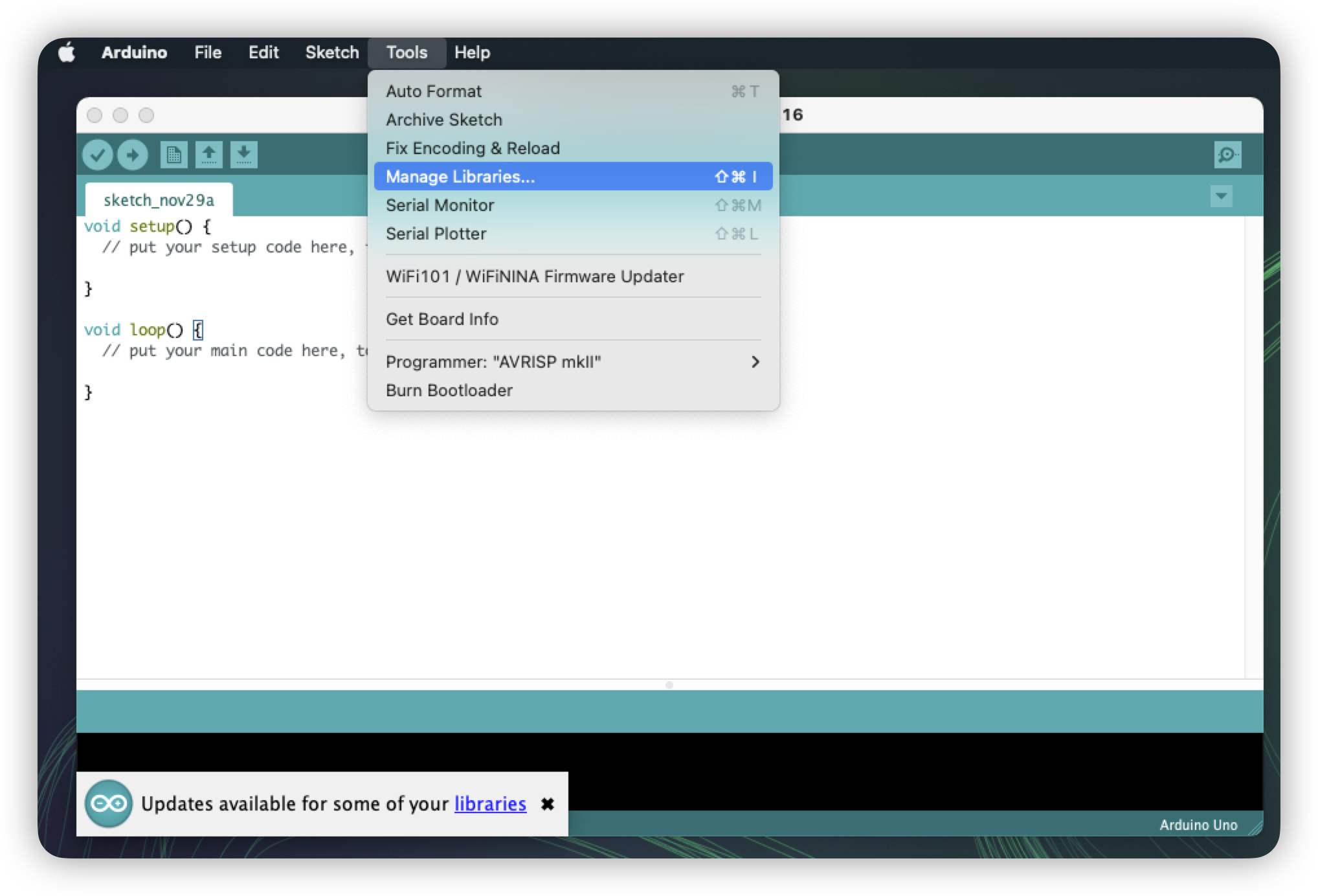
In Arduino IDE, go to `Tools`->`Manage libraries...`
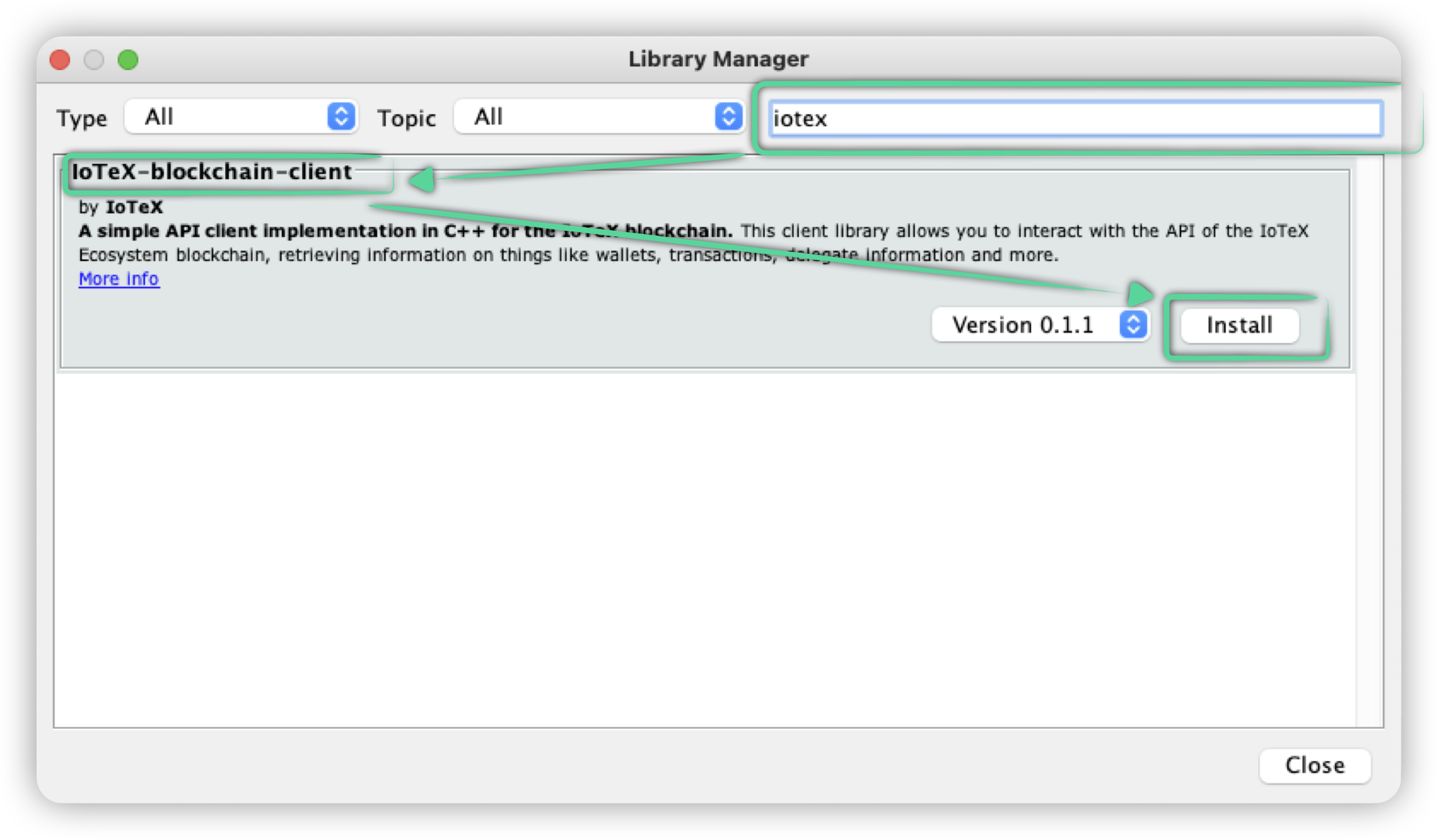
In the Library Manager dialog, search for `IoTeX-blockchain-client` and click `install`
## Dependencies
Using the Arduino IDE built-in Library Manager, also install the following libraries:
* [WiFiNINA](https://github.com/arduino-libraries/WiFiNINA) : used for WiFi functionality in Nano 33 IoT
* [FlashStorage](https://github.com/cmaglie/FlashStorage) : used for EEPROM storage emulation in Nano 33 IoT
## Including the library in your sketch
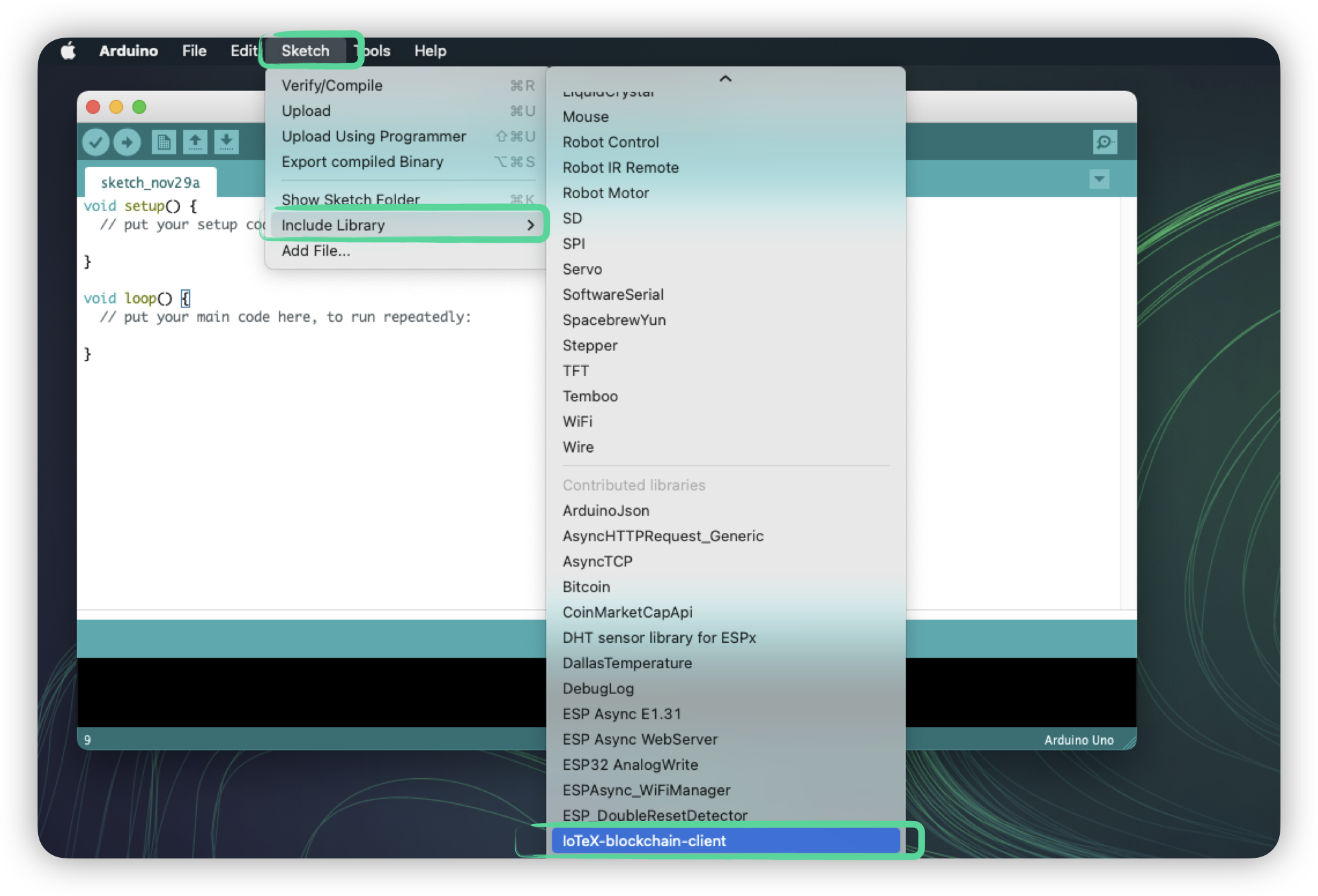
Go to Sketch->Include library and select IoTeX-blockchain-client.
Alternatively, paste the following code `at the` beginning of your sketch:
`#include "IoTeX-blockchain-client.h"`
## Using the library in your sketches
Create the `Connection` object, passing the connection details:
```cpp
const char ip[] = "gateway.iotexlab.io";
const char baseUrl[] = "iotexapi.APIService";
const int port = 10000;
Connection connection(ip, port, baseUrl);
```
Now you are ready to call any of the API methods.
You can find examples of most of the API methods under the [examples](https://github.com/iotexproject/arduino-sdk/tree/main/examples) directory.
## Debug logs
Debug log level is set to NONE by default. The log level can be changed at runtime or at compile time.
Logs are printed to the `Serial` serial port by default. You need to initialize the serial port in your sketch by calling `Serial.begin().`
The log level can be set per module, and also globally. A log statement is printed if it's level is higher than the log level configured for it's module, and higher than the global log level.
### Setting debug log level at run time
The log level can be set at run time using the `IotexHelpers` global object:
#### Setting per module log level
You can set the log level for a specific module. The existent log modules are:
* "GENERAL"
* "HTTP"
* "CONTRACT"
Simply call the following method on the `IotexHelpers` global object:\
`void setModuleLogLevel(const std::string& module, IotexLogLevel level)`
Eg. This will set the HTTP log level to `DEBUG`:\
`IotexHelpers.setModuleLogLevel("HTTP", IotexLogLevel::DEBUG);`
#### Setting the log level globally
You can also set the log level globally for all modules.
Simply call the following method on the `IotexHelpers` global object:\
`void setGlobalLogLevel(IotexLogLevel level)`
Eg. This will set the log level globally to `DEBUG`:\
`IotexHelpers.setGlobalLogLevel(IotexLogLevel::DEBUG);`
---
# Agent Instructions
This documentation is published with GitBook. GitBook is the documentation platform designed so that both humans and AI agents can read, navigate, and reason over technical content effectively. Learn more at gitbook.com.
## Querying This Documentation
If you need additional information that is not directly available in this page, you can query the documentation by asking a question.
Perform an HTTP GET request on the following URL with the `ask` and `goal` query parameters:
```
GET https://docs.iotex.io/blockchain/build/reference-docs/embedded-blockchain-clients/arduino-ide.md?ask=&goal=
```
`ask` is the immediate question: it should be specific, self-contained, and written in natural language.
`goal` is what the user is ultimately trying to achieve, the reason they need the answer. Sharing it helps GitBook give you a better, more relevant answer. A goal is most helpful when it describes the outcome the user wants rather than restating the question. For example, with `ask=how do I create an API token`, a goal like `automate deployments from our CI pipeline` lets GitBook tailor the answer to that use case.
The response will contain a direct answer to the question and relevant excerpts and sources from the documentation.
Use this mechanism when the answer is not explicitly present in the current page, you need clarification or additional context, or you want to retrieve related documentation sections.